

ALCYON’S IP LIBRARY FOR COMPOUNDTEK
Alcyon Photonics and CompoundTek have partnered to offer an extensive product portfolio that empowers the development of reliable photonic integrated circuits (PICs) with qualified designs. Alcyon leverages diverse design techniques to maximize the performance of building blocks while tailoring their features to match the unique requirements of each platform and process constraints. CompoundTek is a global foundry services leader in emerging silicon photonic solutions (SiPh)
delivering revolutionary semiconductor applications designed to meet critical requirements in high bandwidth and high data transfer solutions. The company’s know-how ranges from proprietary fabrication process expertise to design support for end-product manufacturing. The partnership between the two companies has led to the creation of a robust component library, offering key functionalities with competitive performance and rapid fabrication timelines.
What’s inside it?
Alcyon’s IP Library for Compoundtek encompasses a collection of innovative designs protected either through patents or by a trade secret protocol. The library offers a set of functionalities under the SOI platform covering key passive operations present in current photonic integrated circuits: from basic structures (MMIs, DCs,..) to more complex functions such as mode (de)multiplexers, polarization converters and splitters. Alcyon’s IP Library for CompoundTek is in continuous development to expand the functionalities offered and to further improve performance. The roadmap includes the expansion of C-band functionalities as well as
the development of high-bandwidth and polarization management devices for the Oband, which will be essential for future communication applications, sensing or Lidar.
“Our IP Library for CompoundTek evolves to deliver reliable, scalable designs, advancing C- and O-band solutions for future communications, sensing, and LiDAR.”
What are the main features of this library?
Alcyon’s IP Library for CompoundTek has been developed focusing on two main aspects that are cornerstone of a mature and competitive portfolio:
➢ Performance: Alcyon applies its extensive know-how in photonic design to offer cutting-edge components, using the most convenient techniques in each case while keeping in mind feasible sizes and fabrication process limitations.
➢ Reliability: unexpected performance of any device can make a complete PIC useless, which makes reliability an essential feature of any commercial library.
✓ Experimental validation: experimentally validating the designs and testing their replicability across different chips and fabrication batches is a key turning point. It provides users with reliable information, accounts for real-world variability and ensures consistent device performance across diverse applications.
By bridging the gap between simulation and real-world implementation, Alcyon equips its users with tools that are both innovative and reliable, ensuring consistent performance across diverse applications.
LIBRARY PERFORMANCE
In photonic integrated circuit design, each component plays a crucial role in determining the system’s overall functionality and efficiency. The Alcyon IP Library for CompoundTek makes use of sub-wavelength grating (SWG) technology to cover many key passive functionalities present in photonic circuits and offers validated components that are ready to be included in any circuit-level application in a scalable way. The following sections describe these functionalities and show the experimental validation of the offered devices, including their characterization across different chips, demonstrating consistent performance with a scalable foundry process. The Alcyon IP Library includes power management and routing devices such as directional couplers, 1×2 and 2×2 multimode interferometers as well as polarization control building blocks such as polarization beam splitters and polarization converters. Further work is currently being carried out to not only improve the performance of the currently available devices but also expand the functionalities by adding new building blocks to the Alcyon IP Library for CompoundTek.
Power management and routing
Optical power management, particularly routing power along multiple paths, is a fundamental function in nearly all photonic integrated circuits. As a result, building blocks like power splitters and combiners are essential for achieving high-performance and scalable photonic systems. These functions are typically realized using directional couplers (DCs) or multimode interference couplers (MMIs), which are widely used in applications such as transceivers, wavelength division multiplexing (WDM) filters, sensors, reconfigurable circuits, and quantum photonics. Each application imposes specific performance requirements on the devices it relies on.
The DC offered in the Alcyon IP Library for CompoundTek fabricated with 193 nm ArF lithography tool on a 220 nm SOI silicon platform achieves power splitting with a broad bandwidth and low wavelength dependency. The SWG DC offers tunability of the splitting ratio via a change in the length of the device (Figure 1), always maintaining a low splitting ratio deviation. The coupling ratio of the scalable 193nm ArF lithography-fabricated SWG DC is shown in Figure 2 with a comparison to the device patterned using electron beam lithography at Applied Nanotools (ANT) [1].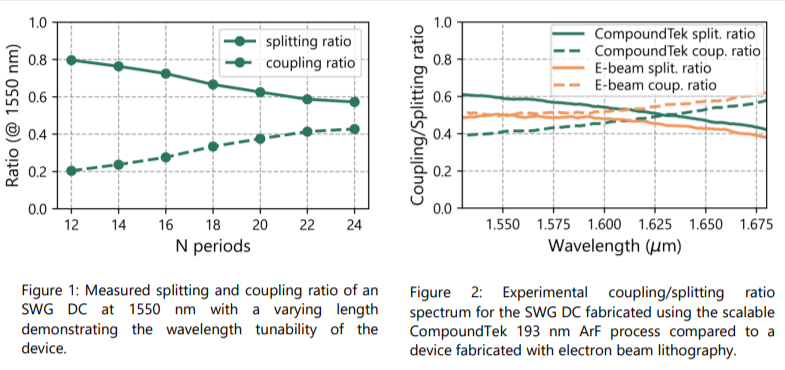
While the shift of the splitting center indicates different refractive indices of the coupling region for these devices, the performance is analogous in both cases with a broad bandwidth, coupling/splitting ratio deviations below ± 0.5 dB over more than 90 nm, and insertion losses on both inputs of the DC below 0.4 dB over of the C L U bands (Figure 3).
The similar functionality of the device fabricated using a precise and slow lithography process compared to the DC patterned via a fast and scalable standard fabrication process demonstrates that the advantages of SWG technology can be realized in a scalable foundry process using the Alcyon IP Library for CompoundTek. A further advantage of the SWG DCs is their smaller footprint compared to standard waveguide-based devices. The length of the SWG DC in the Alcyon IP Library for CompoundTek is only 17 µm, compared to the 30 µm length of standard directional couplers or the 100 µm to 1 mm size of broadband adiabatic DCs [2].
he multimode interference coupler, splitting power evenly between two outputs, is another common device present in many PICs. Thus, its performance, including losses, imbalance, or phase errors, has a tremendous impact on many applications. One of the advantages of MMIs is their broadband nature limited by the wavelength dependence of their beat length (Lπ) which is inversely proportional to the effective index difference of the two lowest-order modes in the multimode region [3].
As SWG technology can be employed to engineer the mode propagation constants, ultrabroadband devices can be designed. Therefore, the Alcyon IP Library for CompoundTek also extends the advantages of SWG technology to broadband multimode interferometers, offering both 2×2 and 1×2 MMI couplers. The experimentally measured imbalance of the 193nm ArF patterned 2×2 MMI is compared to electron beam lithography fabrication by ANT [1] (Figure 4). Both devices demonstrate similar performance with a flat response over the C and L bands and an imbalance below ±0.5 dB. Additionally, the experimental phase error for both inputs of the fabricated device falls below 5⁰ from 1500 nm to 1675 nm (Figure 5).
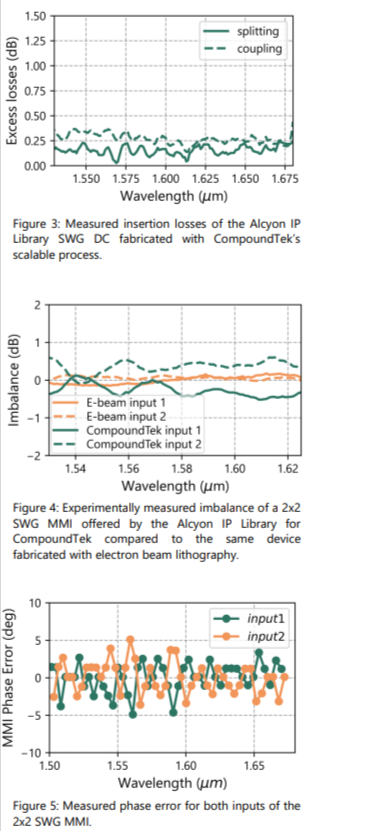
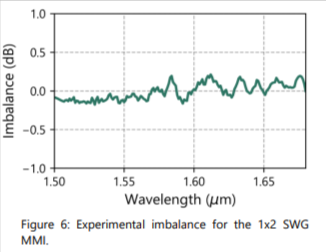
Furthermore, the 1×2 MMI offered by the Alcyon IP Library for CompoundTek demonstrates a similar performance yielding an imbalance below ±0.25 dB for the C L U bands (Figure 6). The excellent performance, as evidenced by these measurements, and the scalability of the CompoundTek 193 nm ArF fabrication process
demonstrate the advantages offered by the building blocks in Alcyon’s IP Library .
Polarization control
Polarization control is a crucial function in integrated photonics, particularly in silicon photonics due to silicon’s high refractive index contrast. While this property enables compact devices and high-power density, it also introduces strong polarization dependence in photonic components. Effective polarization management is essential to ensure reliable PIC operation, regardless of the input light’s polarization state, contributing to more efficient and scalable optical systems. Several on-chip strategies exist for polarization control. One approach involves polarization multiplexing combined with polarization-independent devices, allowing TE and TM modes to be handled within the same architecture. Another method uses polarization diversity, where orthogonal polarizations are separated, and one is rotated to
ensure uniform processing in subsequent circuit stages. These techniques not only enhance optical communication by doubling data capacity but also support the development of more complex and functional photonic systems. The Alcyon IP library for CompoundTek offers several scalable solutions to cover industrial needs
including a polarization converter that rotates modes between TM and TE as well as a polarization beam splitter (PBS).
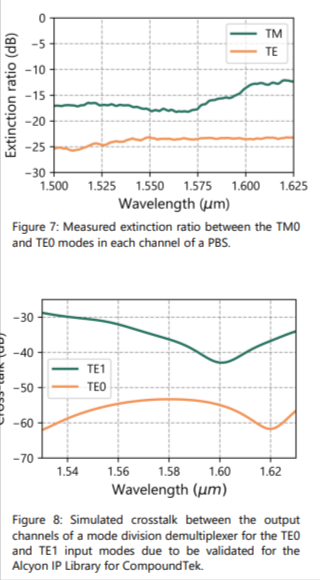
The PBS, designed to separate TM0 and TE0 modes into separate channels, exhibits extinction ratios (ERs) for the two polarization channels as shown in Figure 7. This figure of merit indicates a quality of isolation of the signal polarization in each channel. The Alcyon IP library PBS device demonstrates experimental extinction ratios for the TE0 mode below -23 dB for the C+L band as well as TM0 mode ERs below -15 dB for the C band and below -12 dB for the L band.
Mode division multiplexing
Multiplexing, seen as one of the early advantages of photonics over electronics as it enables the transmission of many signals across the same channel, is also a ubiquitous and important functionality which the Alcyon IP Library for CompoundTek has not neglected. While only theoretical results are available at the moment, work is ongoing on fabricating and validating such a device using 193 nm ArF processing enabling scalable integration into a variety of PICs.
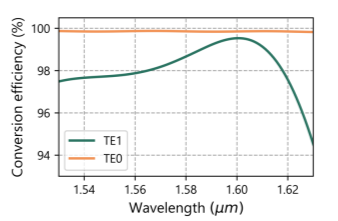
The modal crosstalk, defined as the optical power splitting of each mode between the undesired and desired channels [4], is expected to be less than -28 dB across the entire C+L bands. Figure 8 displays the expected crosstalk for the TE0 and TE1 modes respectively. The device is also expected to demonstrate a mode conversion or (de)multiplexing efficiency above 96% for the TE1 mode and 99% for the TE0 mode along the same bandwidth (Figure 9). This is promising for achieving such an important functionality, enabling many applications of integrated photonics soon provided by the Alcyon IP Library for CompoundTek. This device also opens the door for realizing an efficient polarization splitting rotator (PSR) in this platform, a key component for increasing data transmission capacity in coherent communication systems.
References
[1] Alcyon IP Library for Applied Nanotools NanoSOI. White paper. 2024. [2] K. Solehmainen, K. Markku, M. Harjanne, and T. Aalto. “Adiabatic and multimode interference couplers on silicon-on-insulator.” IEEE Photonics Technology Letters vol. 18, no. 21, pp. 2287-2289, 2006. DOI: 10.1109/LPT.2006.885305 [3] A. Maese-Novo, et al. “Wavelength independent multimode interference coupler.” Optics express vol. 21 no. 6, pp. 7033-7040, 2013 DOI: 10.1364/OE.21.007033 [4] G. Chen, et al. ” Mode-DivisionMultiplexing (MDM) of 9.4-Tbit/s OFDM Signals on Silicon-on-Insulator (SOI) Platform.” IEEE Access vol. 7, pp. 129104-129111, 2019 DOI: 10.1109/ACCESS.2019.2939715.
CONCLUSIONS
The current validated IP Library offered by Alcyon for CompoundTek includes power management devices, such as an SWG DC and various SWG MMIs, as well as polarization control building blocks, such as a PC and PBS. The recorded characteristics of these devices already guarantee outstanding performance for use in photonic integrated circuits, yet work on improving their capabilities is ongoing. As shown by the simulated example of an MDM, Alcyon is also committed to expanding its IP Library for CompoundTek in order to increase functionality and enable a large variety of applications achieved through a standard and fully scalable fabrication process.